
Grade 4/Counting Money
$5 Bills and Coins
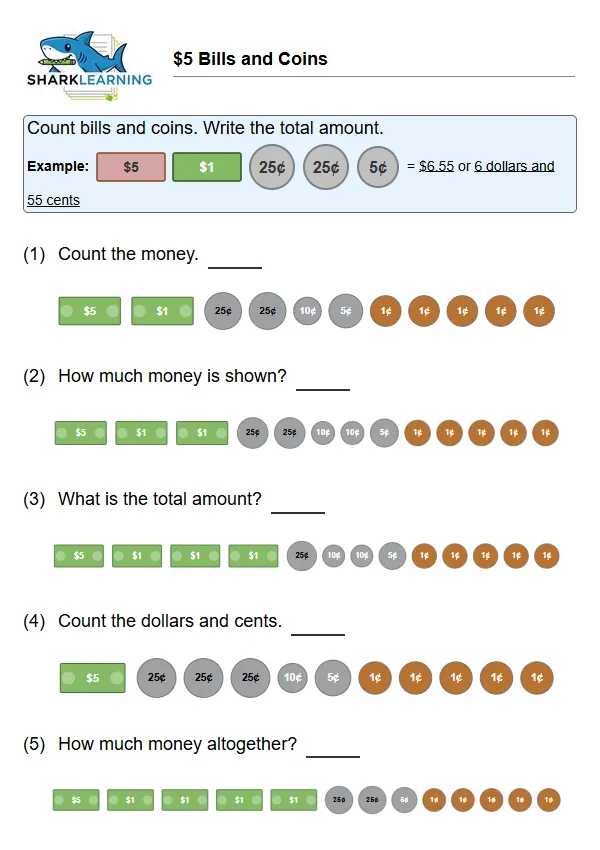
Students practice counting $5 bills combined with $1 bills and coins. This worksheet introduces larger bill values and teaches skip counting by fives with dollars. Students learn to efficiently count mixed bill denominations by starting with the largest value first. Amounts range from $5.00 to $10.99, building confidence with realistic shopping and allowance scenarios.
6
Sheets
2282
Views
332
Downloads
Preview
Tap to open PDF
Preview
Click to preview collection
Teacher Resources
Teaching Notes
Emphasize counting $5 bills first ($5, $10...), then $1 bills, then coins. Connect to real life: allowance, lunch money, small purchases. Use play $5 bills to physically demonstrate their value (worth 5 ones or 20 quarters).
Vocabulary
Bill: Paper money with a specific value.
Coin: Metal money, usually with a smaller value.
Common Mistakes
- Forgetting to count $5 bills first
- Miscounting when mixing $5 and $1 bills
- Writing $510 instead of $5.10
- Forgetting to add all coins.
- Incorrect skip counting by fives.
- Confusing coin values.
- Not starting with largest value first.
Differentiation
SupportUse real money for hands-on practice.
ChallengeCreate shopping scenarios; calculate change.
Discussion Questions
- How many $1 bills equal one $5 bill?
- Why count $5 bills before $1 bills?
- Would you rather have 10 ones or 2 fives? Why?
- Why start counting with the largest bill first?
- How does skip counting help with $5 bills?
- If you had $8, what bills and coins could you have?
- What everyday situations require counting money?
Extension Activities
- Store pricing: Price items $5-$11, practice paying with exact change
- Allowance planning: Weekly allowance of $10, track spending
- Bill exchange game: Trade 5 ones for 1 five, practice equivalence
Parent Tip
Give your child a few coins and bills to count.
Learning Path
Skill Cluster
Financial Literacy & Number Sense
Estimated Time
22 minutes
Skills Practiced
Counting $5 billsMixed bill denominationsAmounts up to $11Largest-first strategy
Prerequisites
- $1 bills and coins
- Skip counting by 5s
- Addition within 20
- Counting $1 bills and coins
- Skip counting by fives
Next Steps
- Making change
- Adding money with larger bills
- Counting $10 Bills and Coins
- Making Change with $5 Bills
- Counting Mixed Bills up to $20