
Grade 2/Counting Money
$1 Bills and Coins
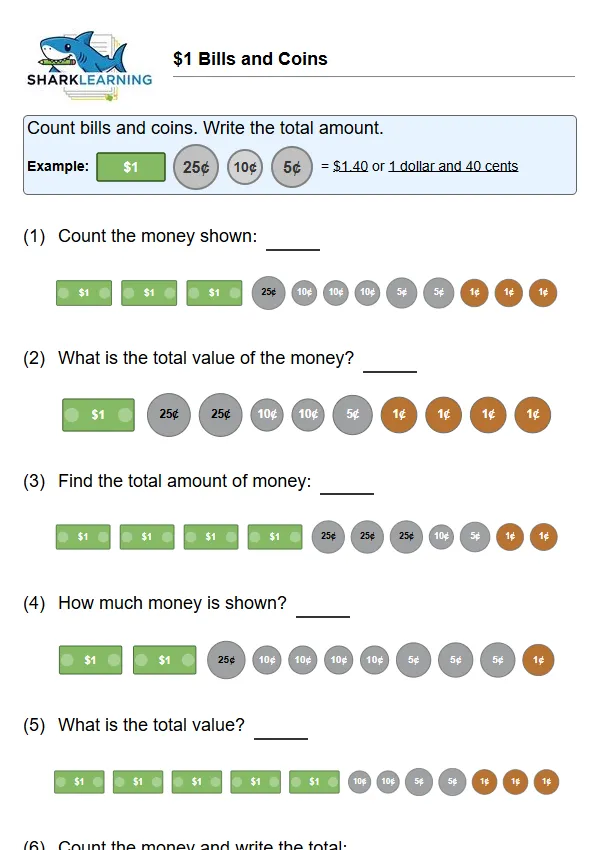
Students begin counting bills and coins together, starting with $1 bills combined with quarters, dimes, nickels, and pennies. This foundational worksheet introduces the strategy of counting bills first, then coins. Amounts range from $1.00 to $5.99, helping students understand that bills represent dollars while coins represent cents.
6
Sheets
1269
Views
574
Downloads
Preview
Tap to open PDF
What to Do Next
Practice Questions
- $1 $1 Quarter 25¢ Quarter 25¢ Dime 10¢ Dime 10¢ Penny 1¢ Penny 1¢ Penny 1¢ = ?
Show answer
$1.73
- $1 $1 $1 $1 Quarter 25¢ Nickel 5¢ Nickel 5¢ Nickel 5¢ Penny 1¢ Penny 1¢ Penny 1¢ Penny 1¢ = ?
Show answer
$2.44
- $1 $1 Dime 10¢ Dime 10¢ Dime 10¢ Dime 10¢ Dime 10¢ Nickel 5¢ Nickel 5¢ Penny 1¢ Penny 1¢ Penny 1¢ Penny 1¢ Penny 1¢ = ?
Show answer
$1.65
- $1 $1 $1 $1 $1 $1 Quarter 25¢ Quarter 25¢ Quarter 25¢ Dime 10¢ Penny 1¢ Penny 1¢ = ?
Show answer
$3.87
- $1 $1 $1 $1 Dime 10¢ Dime 10¢ Dime 10¢ Dime 10¢ Nickel 5¢ Nickel 5¢ Nickel 5¢ Nickel 5¢ Penny 1¢ Penny 1¢ Penny 1¢ Penny 1¢ Penny 1¢ Penny 1¢ = ?
Show answer
$2.66
Preview
Click to preview collection
Teacher Resources
Teaching Notes
First bills + coins worksheet! Emphasize that bills are MUCH more valuable than coins. Teach notation: $2.50 means 2 dollars and 50 cents. Use play money to physically demonstrate counting bills first ($1, $2, $3...) then adding coins.
Vocabulary
Bill: Paper money, like a dollar.
Coin: Metal money, like a quarter.
Total: The final amount after adding.
Common Mistakes
- Adding bills and coins as simple addition (forgetting dollar/cent conversion)
- Writing 2.50 instead of $2.50
- Counting coins before bills
- Confusing coin values
- Not counting bills first
- Incorrectly grouping coins
- Missing dollar or cent symbol
Differentiation
SupportUse real money; group like coins.
ChallengeIntroduce larger bills; calculate change.
Discussion Questions
- Why do we count bills before coins?
- How many pennies equal one $1 bill? (100)
- What does the ".50" mean in $2.50? (50 cents)
- Why is it helpful to count bills first?
- How many ways can you make 75 cents?
- What can you buy with $4.25?
- When do we use money counting skills in daily life?
Extension Activities
- Allowance scenarios: Count weekly allowance with bills and coins
- Lunch money: Pack lunch money using $1 bills and exact change
- Store role-play: Price items, make purchases with bills and coins
Parent Tip
Practice counting a dollar bill with various coins at home.
Learning Path
Skill Cluster
Financial Literacy & Number Sense
Estimated Time
20 minutes
Skills Practiced
Counting $1 billsBills and coins togetherMoney over $1.00Decimal notation for money