
Grade 4/Counting Money
Multi-Step Money Problems
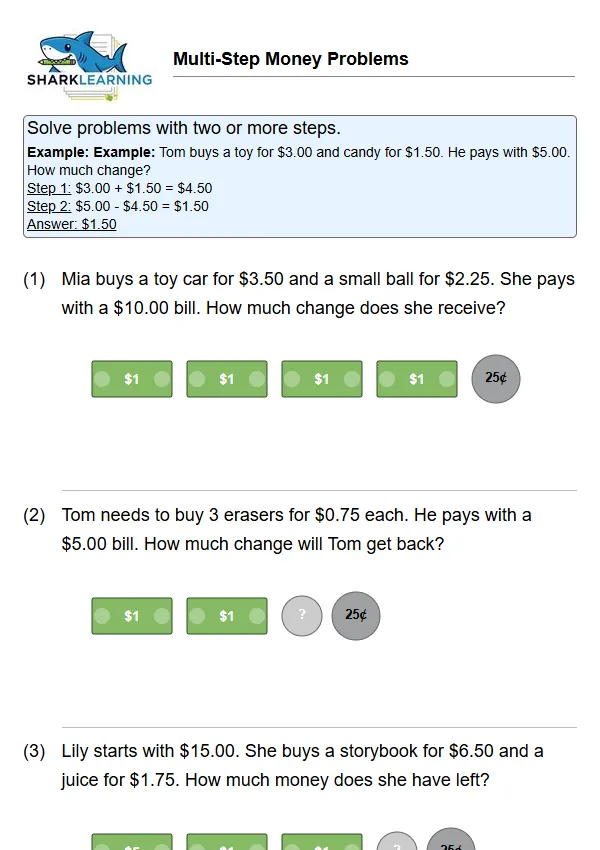
Students solve complex word problems requiring two or more operations with money. These challenging scenarios involve adding multiple purchases then finding change, comparing different spending options, or calculating savings over time. Students develop higher-order thinking skills by identifying what operations to use and in what order. Perfect for advancing problem-solving abilities with real-world applications.
6
Sheets
1523
Views
408
Downloads
Preview
Tap to open PDF
Practice Questions
- 🍦 Sarah buys ice cream for $2.50 and a cookie for $1.25. She pays with $5.00. How much change does she receive?
Show answer
$1.25
- Jake has $10.00. He buys a toy for $3.75 and a ball for $2.50. How much money does he have left?
Show answer
$3.75
- 📚 Emma saves $5.00 in week 1 and $4.50 in week 2. She buys a book for $7.00. How much money does she have left?
Show answer
$2.50
- 🧸 Carlos buys a toy car for $4.25 and stickers for $1.50. He gives the cashier $10.00. What is his change?
Show answer
$4.25
- Lily has $15.00. She buys a game for $6.50. Then she earns $3.00 doing chores. How much money does she have now?
Show answer
$11.50
Preview
Click to preview collection
Teacher Resources
Teaching Notes
Most challenging money word problems! Teach CUBES strategy: Circle numbers, Underline question, Box key words, Evaluate (what operations?), Solve step-by-step. Model breaking complex problems into smaller steps. Use organizers: Step 1: ___ Step 2: ___ Answer: ___
Vocabulary
Total Cost: The combined price of all items bought.
Change: Money returned after paying more than the cost.
Common Mistakes
- Trying to solve in one step instead of breaking down
- Losing track of which operation comes first
- Not reading entire problem before starting
- Missing a step
- Incorrect operation order
- Calculation errors
- Misinterpreting scenario
Differentiation
SupportUse play money manipulatives to act out scenarios.
ChallengeChallenge students to create their own multi-step money problems.
Discussion Questions
- How do you know what to do first in a multi-step problem?
- What strategies help you organize complex problems?
- Why is showing your work important in multi-step problems?
- Why is it important to solve problems step-by-step?
- How do money problems connect to daily life?
- What operation do you use to find change?
- How can you check your answer for reasonableness?
Extension Activities
- Shopping list challenge: Create budget, list items, calculate if within budget
- Problem writing: Students create multi-step problems for partners
- Real scenarios: Plan class party with budget, calculate all costs and change
Parent Tip
Ask your child to calculate the total cost of items when shopping.
Learning Path
Skill Cluster
Financial Literacy & Problem Solving
Estimated Time
25 minutes
Skills Practiced
Multi-step problem solvingOperation sequencingComplex money scenarios