
Subtract Fraction from Mixed Number
Preview
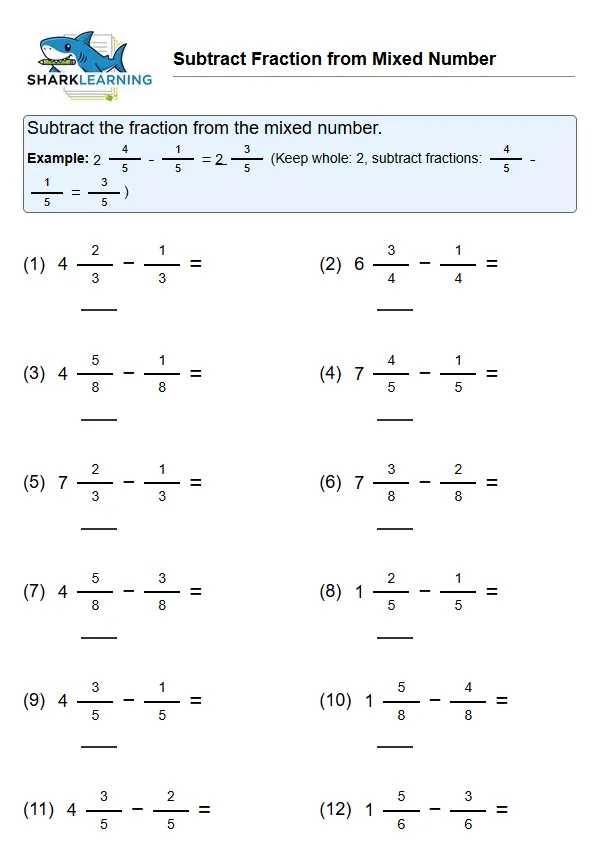
Tap to open PDF
Prerequisites
Practice Questions
- 2 4/5 - 1/5 = ?
Show answer
2 3/5
- 5 7/8 - 3/8 = ?
Show answer
5 4/8
- 3 5/6 - 2/6 = ?
Show answer
3 3/6
- 4 3/4 - 1/4 = ?
Show answer
4 2/4
- 6 9/10 - 4/10 = ?
Show answer
6 5/10
Preview
Click to preview collection
Teacher Resources
Teaching Notes
This collection deliberately avoids borrowing to build confidence first. Teach systematic approach: (1) Check if fractional part is large enough, (2) Keep whole number same, (3) Subtract fractional parts only. Example: 3 5/8 - 2/8 → whole stays 3, subtract 5/8 - 2/8 = 3/8, result is 3 3/8. Use visual aids showing mixed numbers as separate wholes plus fractions. Real context: "You have 2 4/5 pizzas, eat 1/5 of a pizza, how much remains?" This prepares for more complex borrowing situations later. Students learn mixed numbers have independent components that can be operated on separately when appropriate.
Vocabulary
Common Mistakes
- Subtracting from whole number instead of fraction
- Adding instead of subtracting
- Trying to borrow when not necessary
- Forgetting to keep the whole number in the answer
- Forgetting to keep the whole number
- Incorrectly subtracting numerators
- Not simplifying the resulting fraction
- Confusing numerators and denominators
Differentiation
Discussion Questions
- Why does the whole number stay the same in these problems?
- When would you need to borrow? When wouldn't you?
- Can you show 3 4/5 - 1/5 using pictures?
- What real situations involve subtracting from mixed numbers?
- How is this similar to subtracting regular fractions?
- When can you subtract fractions without changing the whole number?
- How is this different from subtracting whole numbers?
- What if the fraction being subtracted was larger?
- How can you check your answer for accuracy?
Extension Activities
- Visual modeling: Draw mixed numbers and show subtraction process
- Real-world scenarios: recipe adjustments, time remaining, distance left
- Pattern exploration: 5 5/6 - 1/6, 5 5/6 - 2/6, 5 5/6 - 3/6... what pattern?
- Estimation practice: Predict result before calculating
- Create word problems matching given mixed number subtractions
Parent Tip
Use measuring cups to show taking away a small amount from a larger mixed amount.
Learning Path
Skill Cluster
Fraction Operations
Estimated Time
12 minutes