Grade 6/Checking AI Answers
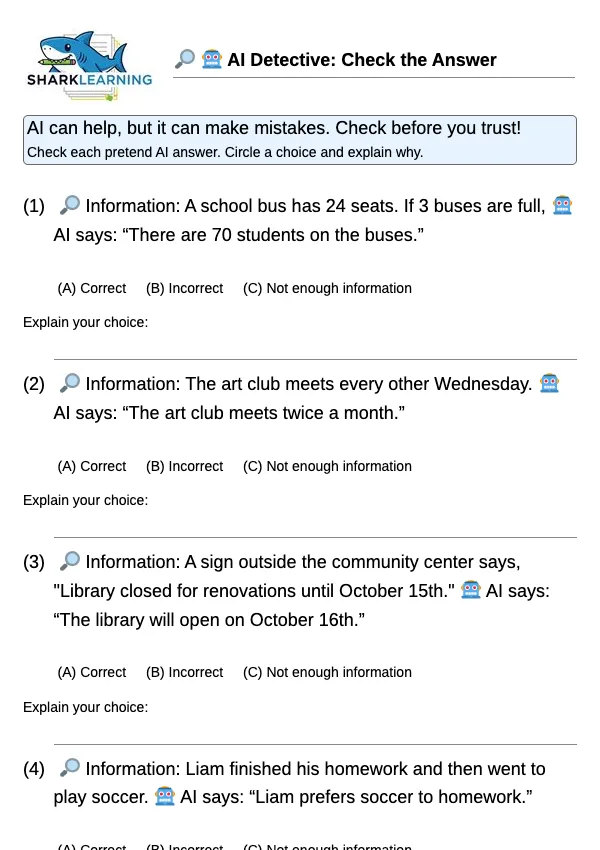
🔎 🤖 AI Detective: Check the Answer
Become an AI detective: check calculations, summaries, assumptions and everyday language, including sarcasm. Use the supplied information to explain whether a sample AI answer is correct, incorrect or needs more evidence.
6
Sheets
5
Views
0
Downloads
Preview
Tap to open PDF
| # | Worksheet | Questions | Actions |
|---|---|---|---|
| Easy | |||
| 1 | 6 questions | ||
| 2 | 6 questions | ||
| Medium | |||
| 1 | 6 questions | ||
| 2 | 6 questions | ||
| 3 | 6 questions | ||
| Hard | |||
| 1 | 6 questions | ||
Practice Questions
- 🔎 Information: A baker made 5 trays with 12 cookies on each tray. 🤖 AI says: “The baker made 50 cookies altogether.”
Show answer
(B) Incorrect
- 🔎 Information: Some pupils enjoyed the trip, but others found it tiring. 🤖 AI says: “The pupils had different opinions about the trip.”
Show answer
(A) Correct
- 🔎 Information: Omar has not replied to a message sent ten minutes ago. 🤖 AI says: “Omar is angry with the sender.”
Show answer
(C) Not enough information
- 🔎 Information: A school notice says the garden club meets on Tuesday. It gives no start time. 🤖 AI says: “The garden club starts at 3:30.”
Show answer
(C) Not enough information
- 🔎 Information: Before Maya goes on stage, her friend smiles and says, “Break a leg!” Maya replies, “Thanks for wishing me luck!” 🤖 AI says: “Her friend is wishing Maya good luck.”
Show answer
(A) Correct
Preview
Click to preview collection
Quick Tip
Check each sample AI answer. Circle a choice and explain why.
Teacher Resources
Teaching Notes
Use the three verdicts to check varied sample AI claims, not just calculations. For sarcasm and idioms discuss how the context supports the interpretation; accept justified uncertainty if a generated example is ambiguous. Inspect one generated worksheet and its answer key before batch generation.
Common Mistakes
- Assuming every AI answer is wrong
- Treating missing information as proof a claim is false
- Believing a confident answer without checking the clue
Differentiation
SupportRead each clue aloud, provide the three labels and let the child explain orally first.
ChallengeAsk which part of a claim the evidence supports and what further information would be needed.
Discussion Questions
- Can a correct-looking answer still need checking?
- How is not enough information different from wrong?
Extension Activities
- Write a pretend answer to one supplied clue. Ask a partner to check it and explain their reasoning.
Learning Path
Skill Level
beginner
Estimated Time
15 minutes
Skills Practiced
Compare a claim with evidenceCorrect a contradicted claimRecognise missing evidence